


















Types of cable hooks: how to choose
A cable hook has to fit two things: the structure it hangs from and the cable or hose it supports. Start with those measurements, then choose the profile. A larger model name alone does not tell you whether a hook will suit your route.

Measure both sides of the hook
Record the supporting tube diameter or structure dimensions, the outside size of each cable or hose, and the combined bundle size. Allow for inserting and removing the lines as well as their position in use. Check the space around bends and connectors; the hook opening is only one part of the route.
Choose the support layout
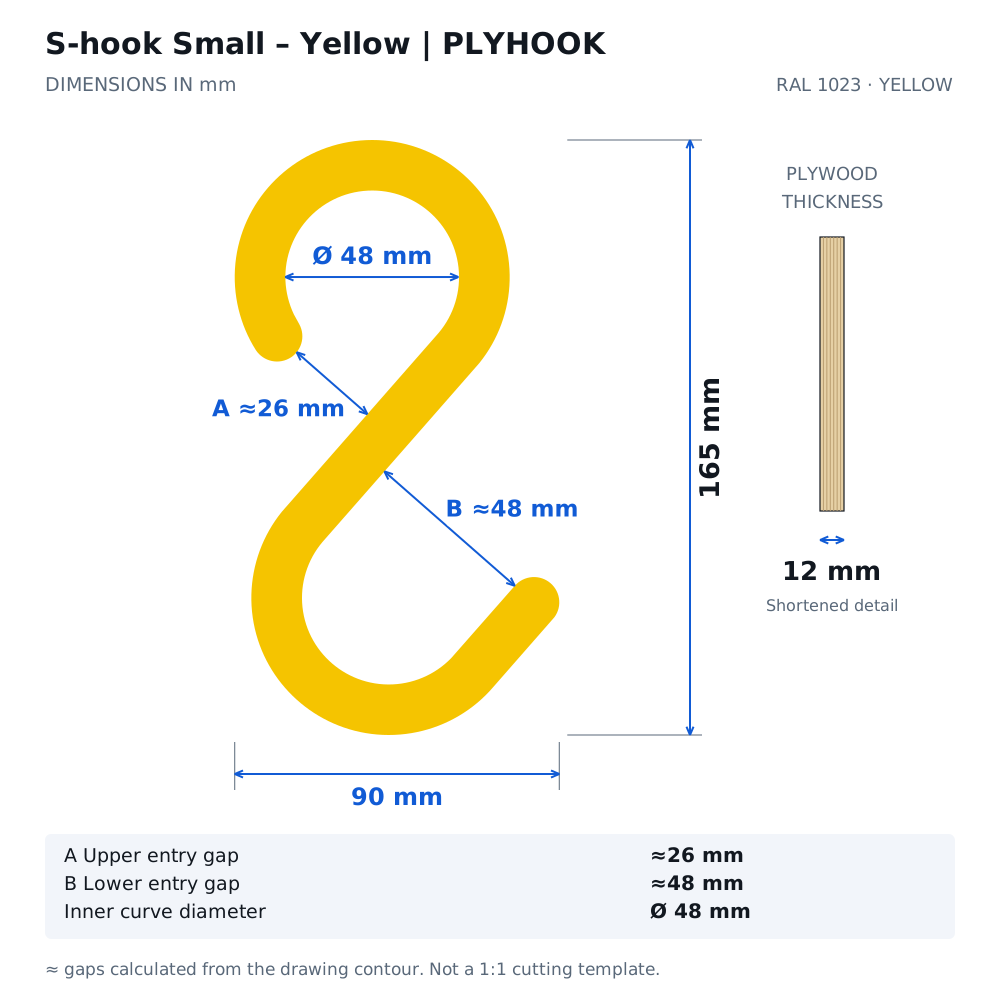
An S-hook provides a curved cradle for a cable or hose bundle. Small, Medium, Large and Extra Large differ in height, openings and plywood thickness. For separate groups, compare the cable hanger family: Single has one lower support, Double two and Triple three. Grande has one enlarged cradle, rather than several levels.
Read the dimensions together
Use the table as a size overview, then inspect the drawing for your exact model. Overall height does not describe the usable opening. S-hook entry gaps are approximate; cable hanger drawings show reference profiles. A close fit needs checking against the finished part or the agreed production drawing.
| Model | Height | Plywood thickness |
|---|---|---|
| S-hook Small | 165 mm | 12 mm |
| S-hook Medium | 230 mm | 15 mm |
| S-hook Large | 310 mm | 18 mm |
| S-hook Extra Large | 390 mm | 21 mm |
Describe the actual working conditions
Include the intended load, support arrangement and how the lines will be handled. The published specifications do not state an approved working load, so thickness must not be used as a load rating. Tell us about movement, moisture or other conditions that affect suitability. The hooks are intended for cable and hose organisation.
Make the enquiry specific
A useful request names the model and finish, gives the measurements, and states the quantity. Add a photograph or sketch of the proposed support when discussing the application with us. If several routes differ, describe them separately: a single model does not have to serve every position.